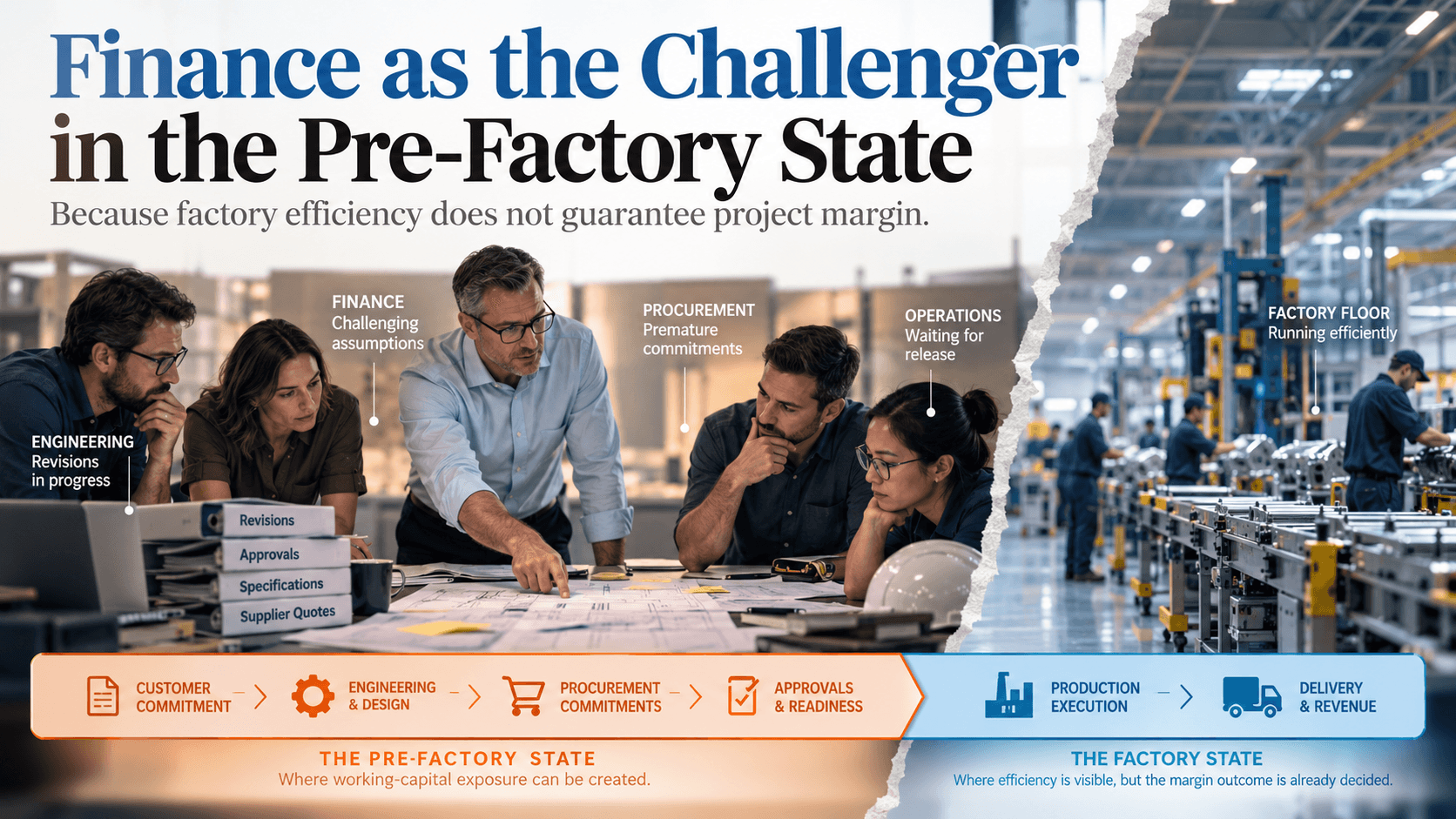
Your factory floor can hit every efficiency metric this quarter while a project is already developing a financial problem upstream.
Labour utilisation is 95%. Machines are running. WIP is moving. Production appears to be performing exactly as planned.
Then the final project P&L arrives.
The margin is materially below expectation.
The immediate instinct is often to look at production. Labour variance. Scrap. Rework. Procurement prices. Machine utilisation. Overheads.
Those factors can absolutely affect project economics.
But in a Build-to-Order or Engineer-to-Order environment, some financial exposure may have been accumulating much earlier, while the order was still waiting to become production-ready.
The part of the order your factory schedule cannot see
The period between customer commitment and production readiness can contain a surprising amount of activity.
Engineering may be working through revisions. Customer specifications may still be changing. Approvals may be outstanding. Compliance documentation may be incomplete. Procurement may be preparing commitments against assumptions that have not yet been locked.
None of these activities necessarily appears as a conventional production inefficiency.
Yet they can consume engineering capacity, extend the time capital remains committed, create premature component commitments, and delay the point at which an order can move into productive execution.
The issue for Finance is therefore not simply whether a project is late.
It is whether Finance can see the operational state creating the financial exposure.
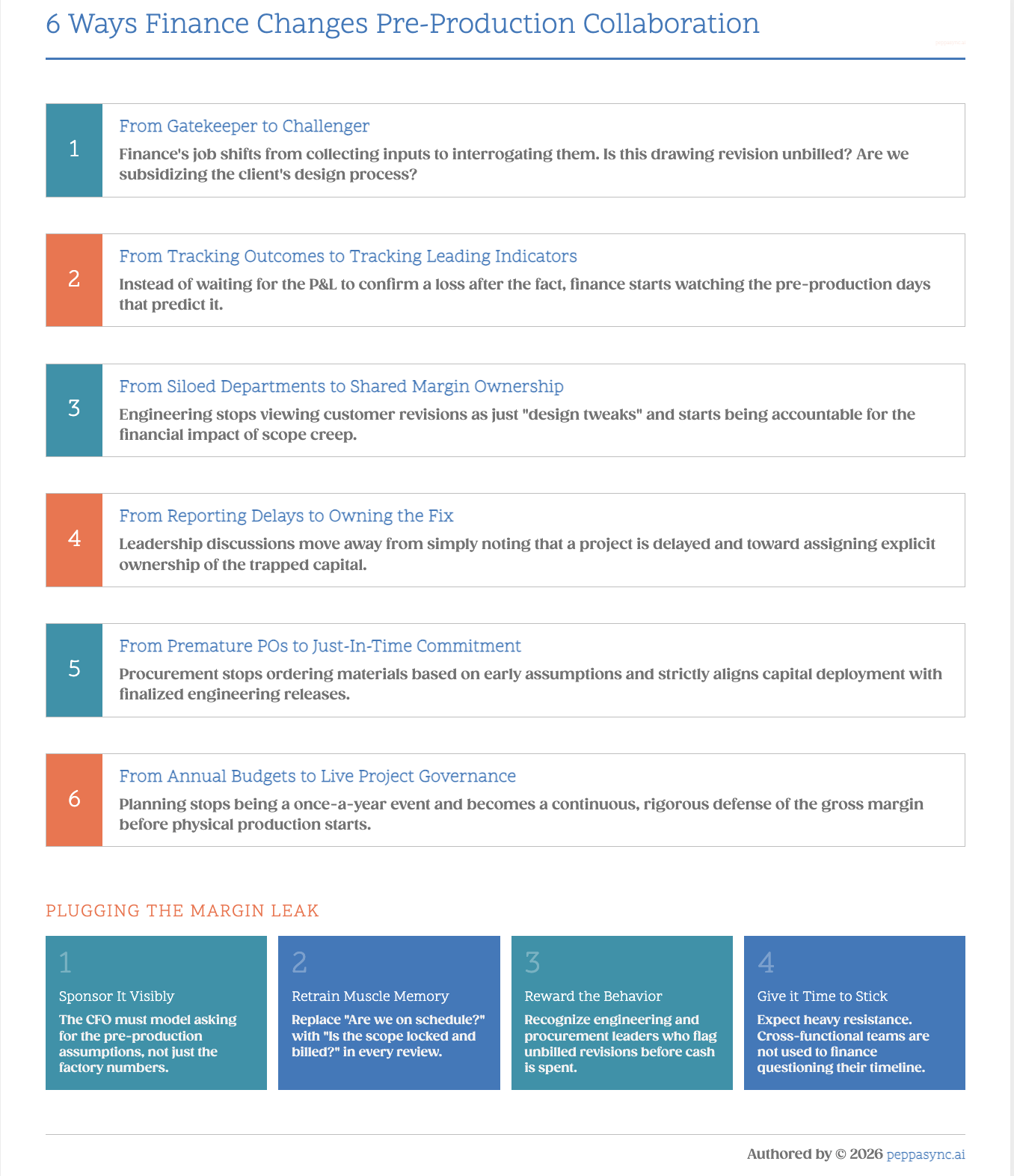
Six shifts from reporting to challenge
The change required is less about building another financial model and more about changing what Finance challenges during project governance.
1. From Gatekeeper to Challenger
Finance has traditionally been asked to collect, validate, consolidate, and report financial information.
In the pre-factory state, that role can become more active.
When an engineering revision appears, Finance should be able to ask:
- Is the revision within the contracted scope?
- Is the additional engineering effort being recognised?
- Is the customer paying for the work?
- Has the commercial position changed?
- Are we committing resources against an assumption that remains unresolved?
The purpose is not to make Finance the owner of engineering decisions.
It is to make financial consequences visible while there is still time to act.
2. From Tracking Outcomes to Tracking Leading Indicators
A project P&L tells Finance what happened.
It does not necessarily explain the operational state that created the result.
By the time a project shows a margin problem, the relevant decisions may have been made weeks or months earlier.
Pre-factory governance introduces a different set of questions.
How long has the order remained in engineering?
How many revision loops has it gone through?
Which prerequisite is preventing release?
Who owns the blocker?
What remains unresolved before production readiness?
These are drivers, not financial outcomes.
An order sitting in engineering for 18 days does not automatically mean a particular amount of money has been lost. But the state is financially relevant because it tells Finance where to investigate exposure and intervention requirements.
3. From Siloed Departments to Shared Margin Ownership
Engineering can experience a drawing revision as a technical requirement.
Finance may experience the same revision as a potential margin issue.
Procurement may experience it as a purchasing decision.
Operations may experience it as a production-readiness delay.
The order, however, experiences all of these simultaneously.
That is why the financial consequence cannot remain inside one departmental silo.
When customer revisions create additional engineering effort or change the basis for procurement commitments, the teams involved need a shared view of the commercial and operational implications.
Margin ownership therefore becomes a cross-functional discipline rather than something Finance discovers retrospectively.
4. From Reporting Delays to Owning the Fix
A weekly meeting can establish that a project is delayed.
That is useful information.
It becomes more valuable when the meeting also establishes why the order is delayed, who owns the blocker, what prerequisite is missing, and what financial exposure may be accumulating while the order remains unresolved.
This changes the conversation.
Instead of repeatedly reporting the same status, the team starts governing the condition preventing production readiness.
That distinction matters because reporting describes the state.
Governance creates accountability around changing it.
5. From Premature POs to Just-in-Time Commitment
Procurement activity can begin before engineering is genuinely complete.
There may be understandable reasons for this. Lead times can be long. Teams may want to protect production schedules. Suppliers may require early commitments.
But purchasing against specifications that continue to change can introduce its own exposure.
The objective is not to eliminate early procurement.
It is to distinguish justified early commitments from commitments made before the underlying production requirements are sufficiently stable.
A stronger governance model therefore connects capital deployment to engineering release and production-readiness criteria.
6. From Annual Budgets to Live Project Governance
Annual budgets remain important.
They establish financial expectations and provide a basis for planning.
But they cannot govern the changing state of individual orders throughout the year.
For active BTO projects, Finance needs a more continuous view.
Which orders are moving toward production readiness?
Which are stalled?
Where are revision loops accumulating?
Where are approvals unresolved?
Where has procurement begun before the engineering basis is stable?
Where is capital being consumed while the order remains outside production?
This is where working-capital management becomes an operational discipline rather than a periodic reporting exercise.
The Finance function changes when the questions change
These six shifts do not require Finance to take over Engineering, Procurement, or Operations.
They require Finance to ask different questions of those functions.
The question moves from:
"What happened to the margin?"
toward:
"What operational conditions are creating exposure before production begins?"
That is a fundamentally different management conversation.
It also changes what counts as useful information.
A project dashboard showing revenue, cost, margin, and forecast remains valuable. But those outcomes become more actionable when Finance can connect them to the operational states that preceded them.
The engineering queue.
The revision loop.
The unresolved approval.
The missing specification.
The premature purchase order.
The order that has not reached production readiness.
This is where Pre-Factory State Governance matters
Custom manufacturers already have systems for much of this information.
ERP systems can hold commercial and financial records. Engineering systems can manage technical information. Procurement systems can manage purchasing activity. Spreadsheets, emails, meetings, and project reports fill additional gaps.
The challenge is often the relationship between these pieces.
Finance may have the financial record without having a persistent view of the operational state creating the exposure.
That is the governance gap.
Pre-Factory State Governance provides a way to maintain visibility across the period between customer commitment and production readiness, including blockers, ownership, elapsed time, prerequisites, and potential capital exposure.
The operating model is straightforward:
INGEST → GOVERN → RELEASE
Capture the fragmented information.
Govern the state of the order.
Release genuinely execution-ready work into production.
The practical question for Finance leaders
The objective is not to make every pre-production delay a financial event.
Nor is it to turn Finance into a policing function for Engineering and Procurement.
The objective is to give Finance enough visibility into the pre-factory state to challenge assumptions before financial exposure becomes a retrospective explanation.
That means asking different questions in project reviews.
Is the scope locked?
Is the engineering work commercially understood?
What is preventing production readiness?
Who owns that blocker?
What capital has already been committed?
What remains exposed while the order waits?
Those questions move Finance closer to the point where working-capital exposure is being created.
And that is where Finance can become a challenger rather than simply the function that reports what happened afterwards.
For manufacturers with substantial pre-production activity, the opportunity is to govern that state deliberately: understand where orders are becoming stuck, identify the operational drivers creating exposure, and intervene before capital remains trapped longer than necessary.
That is the role of Pre-Factory State Governance.