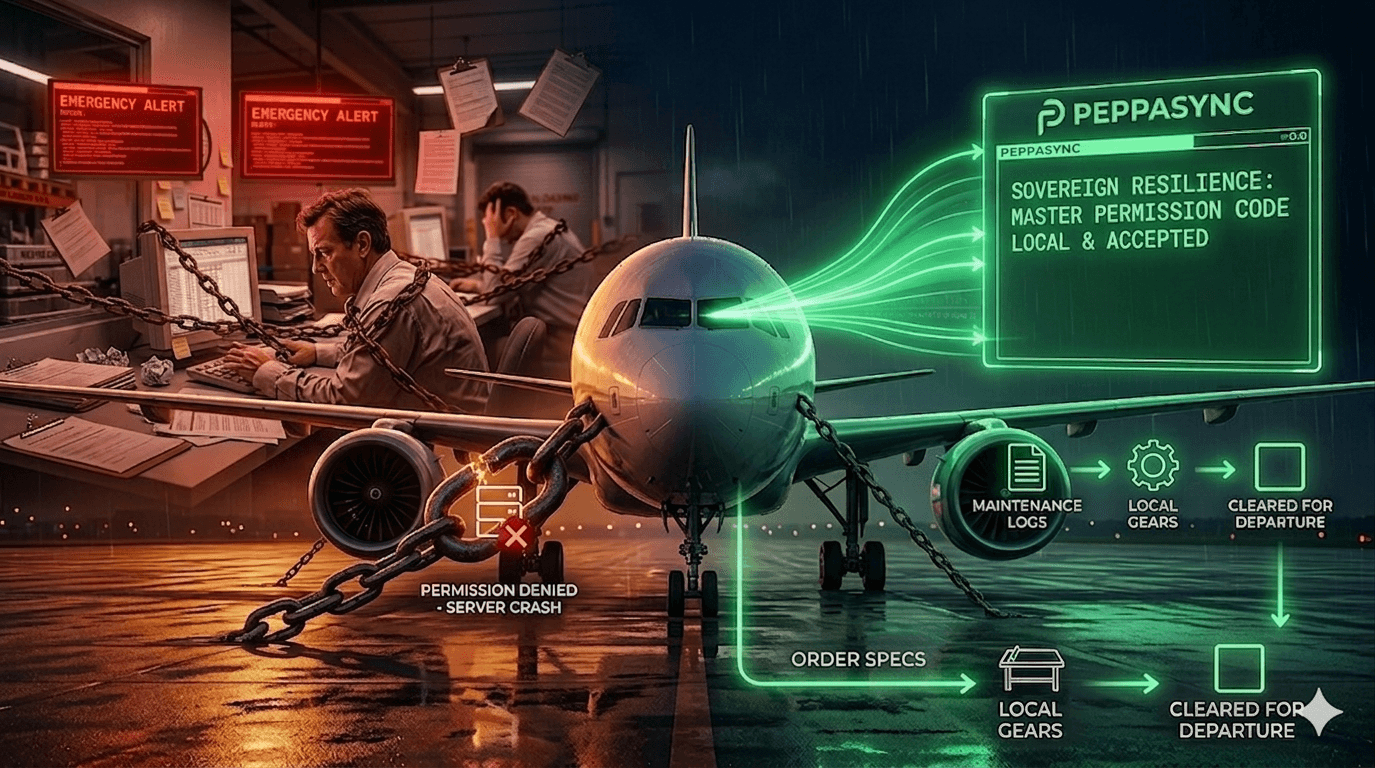
Sovereign Resilience in the Skies
Flight 482 is sitting at the gate. The weather is clear. The massive turbine engines have passed every physical inspection. The flight crew is strapped in. But the $100 million jet is grounded, and the departure board is flashing red.
Why? Because a routine maintenance clearance code is stuck. It is not stuck in the airplane. It is trapped in a third-party vendor’s crashed server, sitting in a data center three time zones away.
This is the reality of modern aviation. Airlines do not have an engineering problem; they have a plumbing problem.
To explain this to my grandmother, I use the kitchen analogy. Imagine you own a bakery. You have the flour, the ovens are hot, and the bakers are ready to work. But every time you want to turn on the oven, you have to wait for the oven manufacturer to send you a daily fax with a permission code. If their fax machine runs out of paper, your entire bakery shuts down. You might own the building, but you do not own your business. You are just renting permission to bake.
In aviation, this is the fatal flaw of relying on fragile, external data pipes. When you do not own the master machinery dictating your supply chain, maintenance logs, and flight operations, you lack sovereign resilience. You are entirely at the mercy of someone else’s broken gears.
Look closely at your hangars and your dispatch centers. Are your highly trained aviation engineers actually building better operational flows, or have they become Data Janitors, sweeping up broken logs from a dozen disconnected vendor portals? Are your dispatchers routing aircraft, or are they just acting as Human Glue, manually copying and pasting numbers between screens to hold a fragile system together?
It is time to challenge synchronous logic. Synchronous logic is the dangerous operational habit of forcing System A to wait for System B to respond before taking action. It is the mechanic standing at the landing gear, wrench in hand, waiting for an external database to load a green checkmark. It creates massive, invisible traffic jams across your entire fleet.
To scale securely, you must kill synchronous logic. You must inject sovereign resilience into your operations. This means building a local engine that you control, allowing your internal teams to orchestrate maintenance and flight data without routing every single decision through an external vendor's tollbooth.
💎 The Maintenance Pipeline: Spreadsheet Reality vs. Peppasync Reality
| Operational Metric | Spreadsheet Reality (External Dependency) | Peppasync Reality (Sovereign Resilience) |
|---|---|---|
| Data Governance | Rented pipes. If the vendor's cloud goes down, your planes are grounded. | Sovereign gears. You hold the master data locally; your factory never stops. |
| System Operations | Human Glue manually typing part numbers into four different external portals. | Single, governed traffic control. Automated data flow with zero friction. |
| Logic & Execution | Synchronous logic. Waiting for third-party servers to grant permission to act. | Asynchronous local engine. Mechanics work while the system syncs in the background. |
| Resolution Speed | Hours spent on the phone acting as Data Janitors trying to locate missing digital logs. | Instant orchestration. The engine knows where the data is and delivers it to the tarmac. |
We don't sell software. We sell a factory that finally works.
When you govern your own data infrastructure, you stop reacting to external failures and start dictating your own operational tempo. You orchestrate the exact flow of parts, maintenance clearances, and compliance logs through your own heavy-duty pipes.
Sovereign resilience means that even if the rest of the global supply chain goes dark, your internal gears keep spinning. Stop renting your operational capacity. Build the engine.