Synchronous vs. Asynchronous Logic: Why Mid-Market E-commerce Brands Outgrow Basic Middleware
AI Summary (TL;DR): Mid-market e-commerce brands often face data bottlenecks during peak seasons like Black Friday or when processing complex Build-to-Order (BTO) workflows. This is caused by Synchronous Middleware, which processes data in a linear, "one-at-a-time" queue. To scale, brands require an Asynchronous Logic Engine that decouples tasks, prevents API rate-limiting, automates stage gates, and ensures "Eventual Consistency" across ERP, WMS, and Shopify.
What’s Really Happening Behind the Scenes?
For a mid-market e-commerce brand, the "Back Office" is a high-stakes air traffic control center. You aren't just moving boxes; you are moving data. Your tech stack looks like this:
- The Front End: Shopify, BigCommerce, or Adobe Commerce.
- The Middleware: The bridge (or the bottleneck) connecting everything.
- The Back End: Your ERP (NetSuite, Sage, Microsoft Dynamics), WMS, and Ad Managers.
The "Happy Day" vs. The "Sad Day"
- A Happy Day: Orders flow instantly to the warehouse, inventory levels reflect reality across all channels, custom BTO orders hit the correct stage gates automatically, and your team spends their time on strategy, not spreadsheets.
- A Sad Day: It’s Black Friday. Traffic spikes. Suddenly, the ERP is lagging, Shopify is overselling out-of-stock items, and your Head of Ops is manually re-syncing 5,000 orders at 3:00 AM because one "Ghost Order" crashed the queue.
The 8 Headaches of "Dumb" Middleware
If you’ve asked these questions, your middleware is likely Synchronous (Dumb):
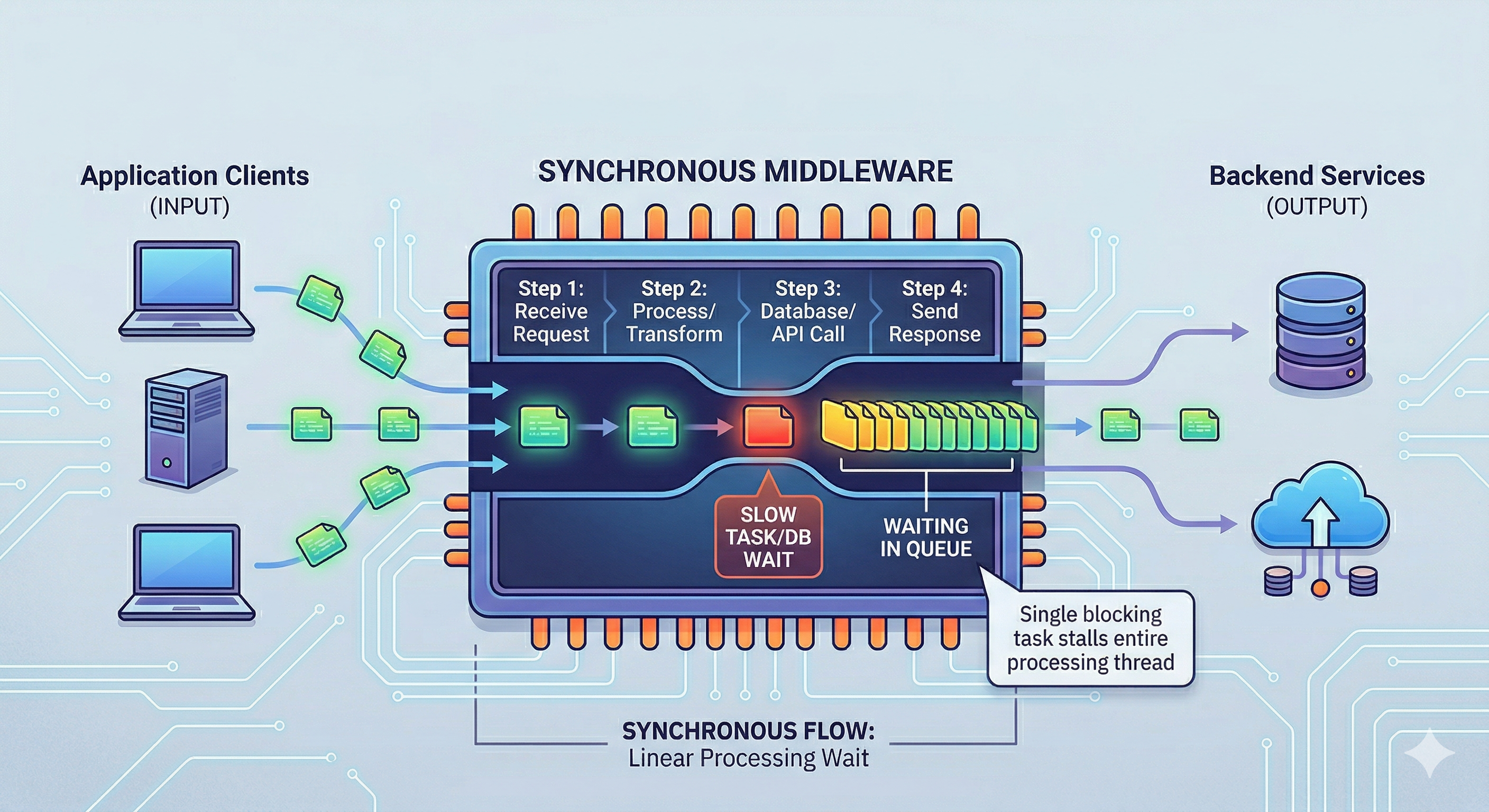
- "Why is my ERP taking so long to sync?" It’s waiting for a "Success" signal from every single line item before moving to the next.
- "Why did we oversell after we sold out?" Synchronous lag means Shopify is "lying" to customers because the ERP hasn't been able to "tell" it the stock is gone yet.
- "Why did one bad order stall the whole queue?" In linear processing, if Order #101 has a typo, Orders #102–#5000 sit in a digital traffic jam waiting for a fix.
- "Why are we hitting API rate limits?" Dumb middleware hammers your ERP/Shopify API until it gets blocked, rather than "buffering" the data intelligently.
- "Why are shipping updates 12 hours late?" Your system is waiting for the ERP to "confirm" each label individually—a slow process that creates a massive backlog.
- "Why do we have to manually 'Re-Sync' every morning?" Your system lacks "Self-Healing." A tiny flicker in connection creates a permanent data gap.
- "Why is my 'True Margin' invisible?" Calculating landing costs in a synchronous sync is too slow, so your team does it manually in Excel—usually too late to matter.
- "Why are we tracking custom orders in a spreadsheet?" Your middleware doesn't understand Build-to-Order (BTO) workflows, forcing your team to manually manage stage gates (Finance, Design, Factory) outside the system.
The Core Problem: Sync vs. Async
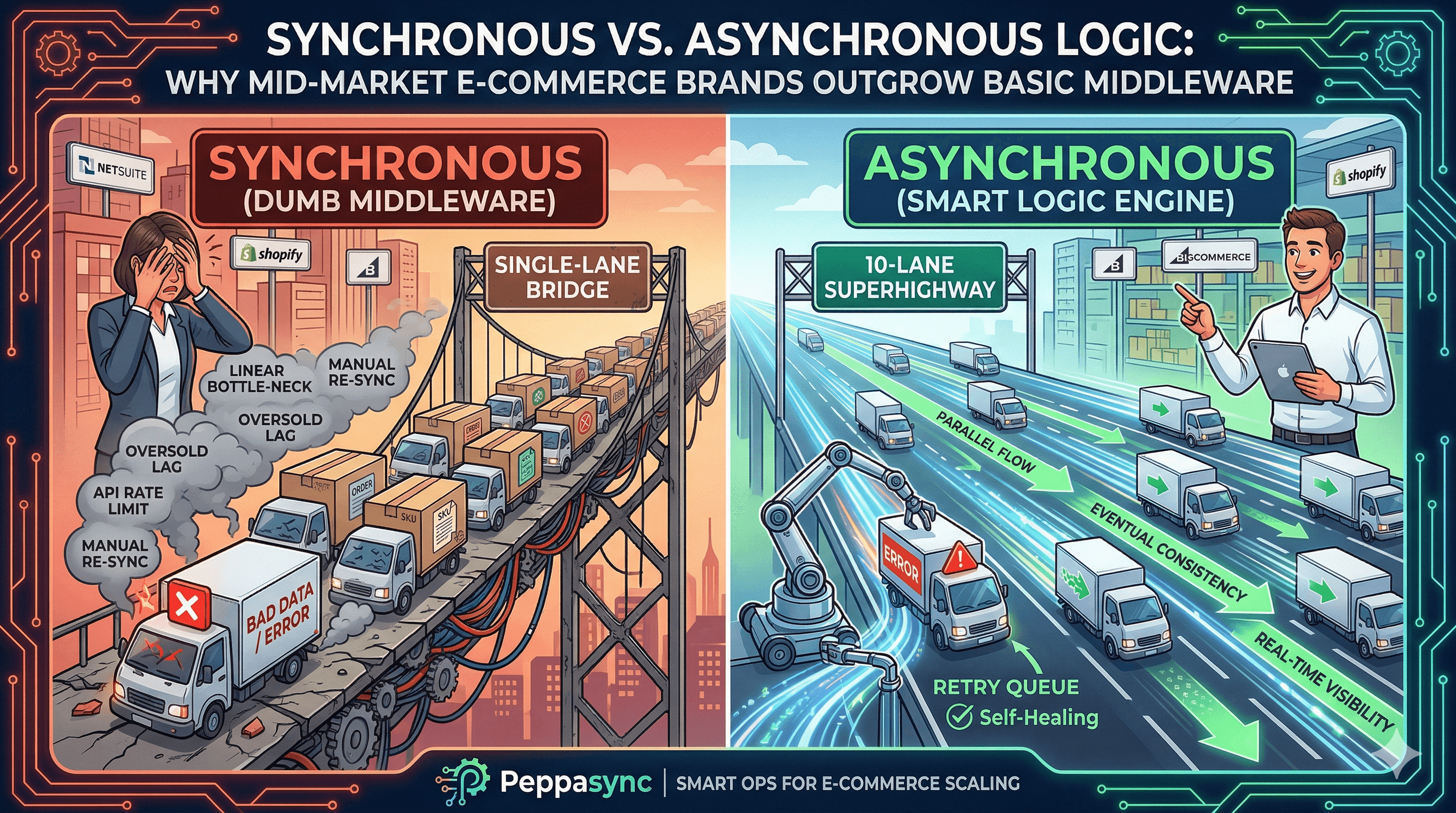
In layman's terms, think of a Synchronous (Sync) system like a single-lane bridge. Only one car can cross at a time. If a truck breaks down (a data error), the entire highway stops.
An Asynchronous (Async) system is a 10-lane superhighway with a smart toll booth. Cars move independently. If one car breaks down, it’s pulled into the shoulder (a retry queue), while the rest of the traffic zooms by at 70 mph.
- Dumb Middleware is synchronous. It’s "linear."
- Smart Middleware (powered by an Asynchronous Logic Engine) is "parallel."
The "Easy Life": Scaling to 10x with Ease
Imagine a Black Friday where a 10x surge in SKU variations doesn't crash your ERP. Imagine orchestrating complex BTO workflows where automated "Logic Holds" manage your Finance and Factory stage gates without a single spreadsheet. This is the "Happy Day" powered by an Asynchronous Logic Engine.
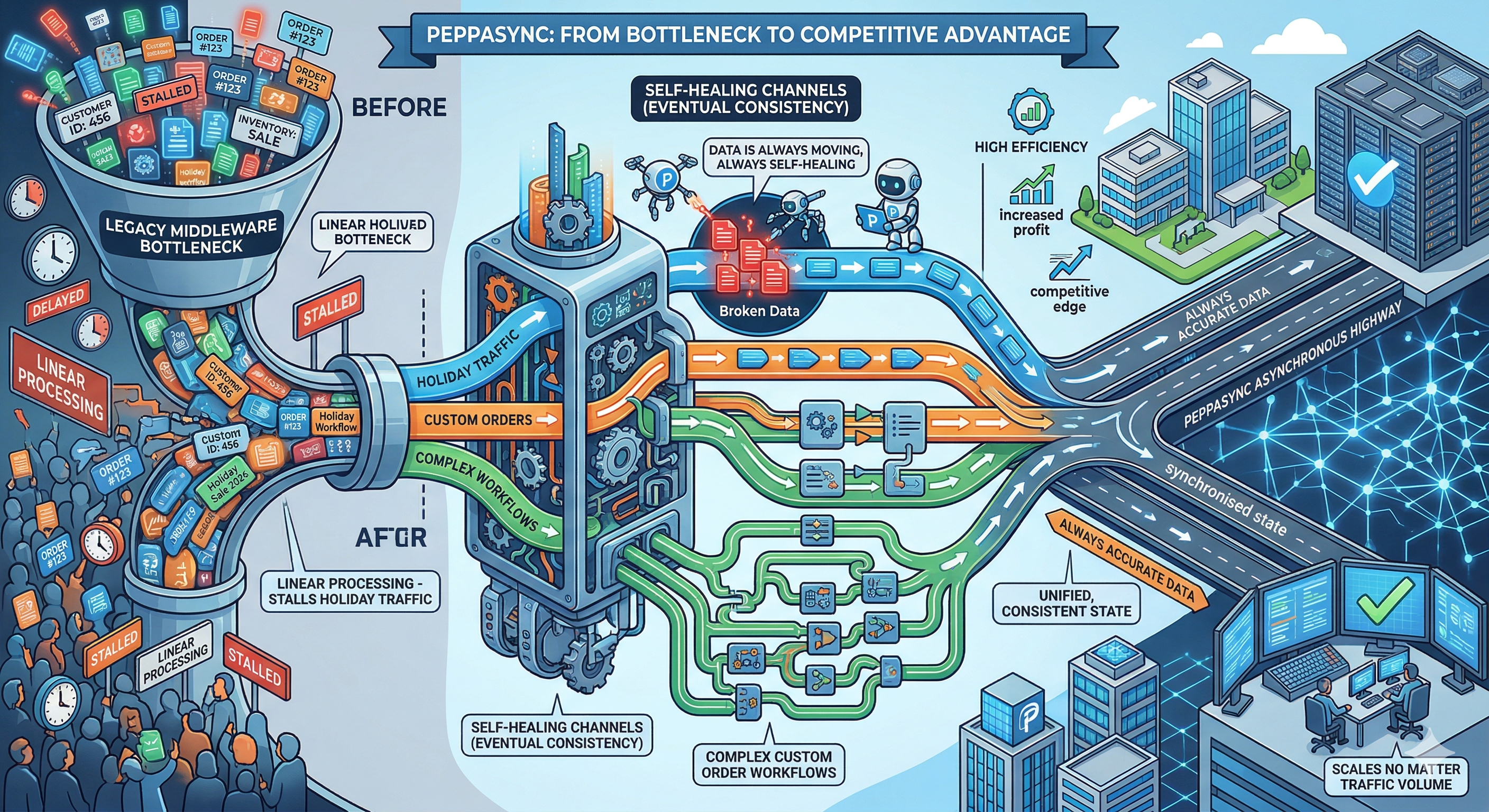
Instead of "hammering" your API, the engine throttles and drips data based on what the ERP can handle. Instead of crashing on an error, it segregates the "Ghost Order" and keeps the fulfillment line moving. You get Real-Time Visibility because the logic is calculated in the background, not in the middle of the sync.
Enter Peppasync: The Future of Mid-Market Ops
This isn't a pipe dream. It’s what we built Peppasync to do.
By utilizing a dedicated Asynchronous Logic Engine, Peppasync transforms your middleware from a bottleneck into a competitive advantage. We ensure "Eventual Consistency," meaning your data is always moving, always self-healing, and always accurate—no matter how much traffic the holidays throw at you or how complex your custom order workflows get.
Stop Guessing. Start Scaling.
Is your middleware holding your growth hostage? Don't wait for the next "Sad Day" to find out where your bottlenecks are.
Book a Free Ops Audit with Peppasync Today
We’ll identify the exact data bottlenecks in your business and show you how Asynchronous Logic can unlock your next stage of growth.