The $300K Silent Failure: Turning E-Commerce Sync Drops Into Competitive Wins
AI Summary (TL;DR): When synchronous middleware hits a data error, it stops the entire line. Thousands of orders can be dropped or delayed without triggering an immediate alarm, costing mid-market brands hundreds of thousands in lost revenue and SLA penalties. An Asynchronous Logic Engine solves this by isolating errors and processing the rest of your traffic in parallel.
When your competitors can process and route complex fulfillment logic in milliseconds while you are still manually exporting CSVs to figure out where your data pipeline broke, you aren't just behind—you are bleeding revenue.
The Wednesday That Changed Everything
It’s 1:00 PM on Wednesday, and the commercial leadership team is deep into their midweek review. Dashboards glow on screens showing massive sales numbers from a recent influencer campaign. Everything looks like a massive success—until the Head of Operations spots a terrifying anomaly.
"Shopify is showing 5,000 orders processed since Monday," she says, pointing to the screen. "But our 3PL warehouse portal is only showing 1,200."
As panic starts spreading across the room, the VP of Engineering quickly logs into their standard iPaaS connector logs.
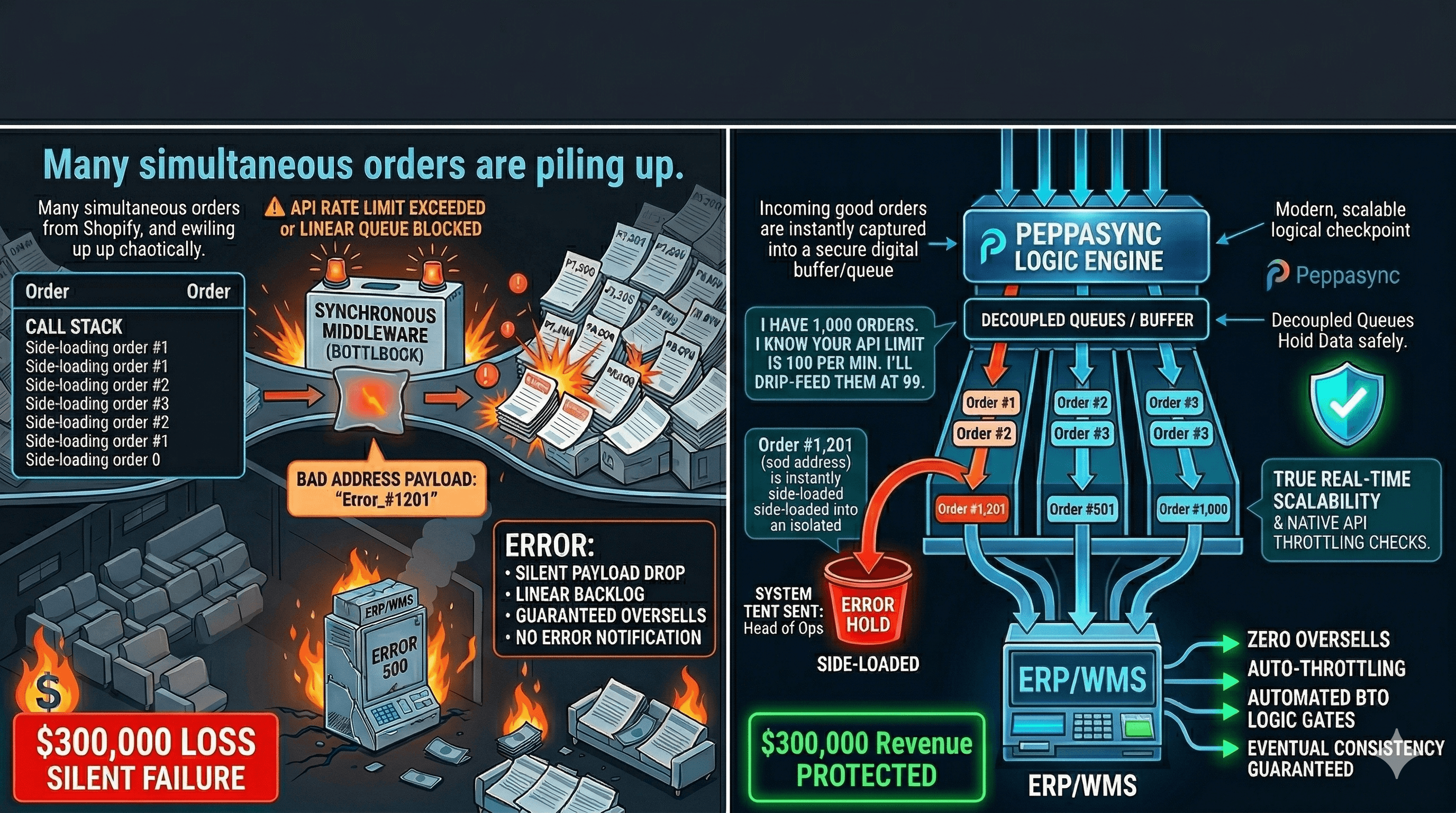
The devastating reality: On Monday afternoon, Order #1,201 contained a strange character string in the shipping address. The synchronous middleware didn't know how to translate it for the ERP. It tried to push the data, failed, tried again, and eventually timed out.
Because synchronous logic operates like a single-lane bridge, that one bad order blocked the entire connector. Orders #1,202 through #5,000 were trapped in limbo.
The warehouse had been sitting idle for two days while the marketing team celebrated.
When Every Hour Counts: The $300K Lesson
In Generation 2 (Synchronous) middleware, the worst errors aren't the loud ones—they are the silent ones.
Consider a real scenario from a mid-market Build-to-Order (BTO) furniture brand. During a holiday sale, their inventory sync connector experienced a micro-outage of just 45 seconds. The connection re-established, but the system had silently dropped the payload containing the latest stock deductions.
Shopify thought a flagship sofa was still in stock. It continued selling for another 24 hours. By the time the operations team caught the discrepancy, they had oversold $300,000 worth of custom inventory they didn't have the materials to build.
The damage? $300,000 in refunded revenue, thousands wasted in customer acquisition costs (CAC), and irreparable damage to their brand reputation. All because a "dumb" connector dropped a payload and didn't have the logic to try again.
The Competitive Reality: Linear Logic vs. Asynchronous Logic
The Generation 2 (Synchronous) Reality Check:
- Single Point of Failure: One bad payload stops the entire sync queue.
- Silent Drops: API timeouts result in permanently lost data.
- Manual Intervention: Operations teams spend hours acting as "data janitors" to find and re-push stuck orders.
- Revenue Hemorrhage: Oversells and delayed fulfillments kill margins.
The Generation 3 (Asynchronous) Advantage:
- Error Side-Loading: If Order #1,201 has a bad address, the engine isolates it into an "Error Hold" bin and immediately processes the other 3,799 orders in parallel.
- Eventual Consistency: Decoupled queues guarantee data is never dropped. If the destination system goes down, the engine safely holds the payload and delivers it when the system returns.
- Automated BTO Gates: The engine understands complex logic, holding orders dynamically based on factory capacity or pre-payment status.
- Zero Oversells: True, scalable traffic processing ensures inventory levels are always trusted.
What This Means for Your Operations
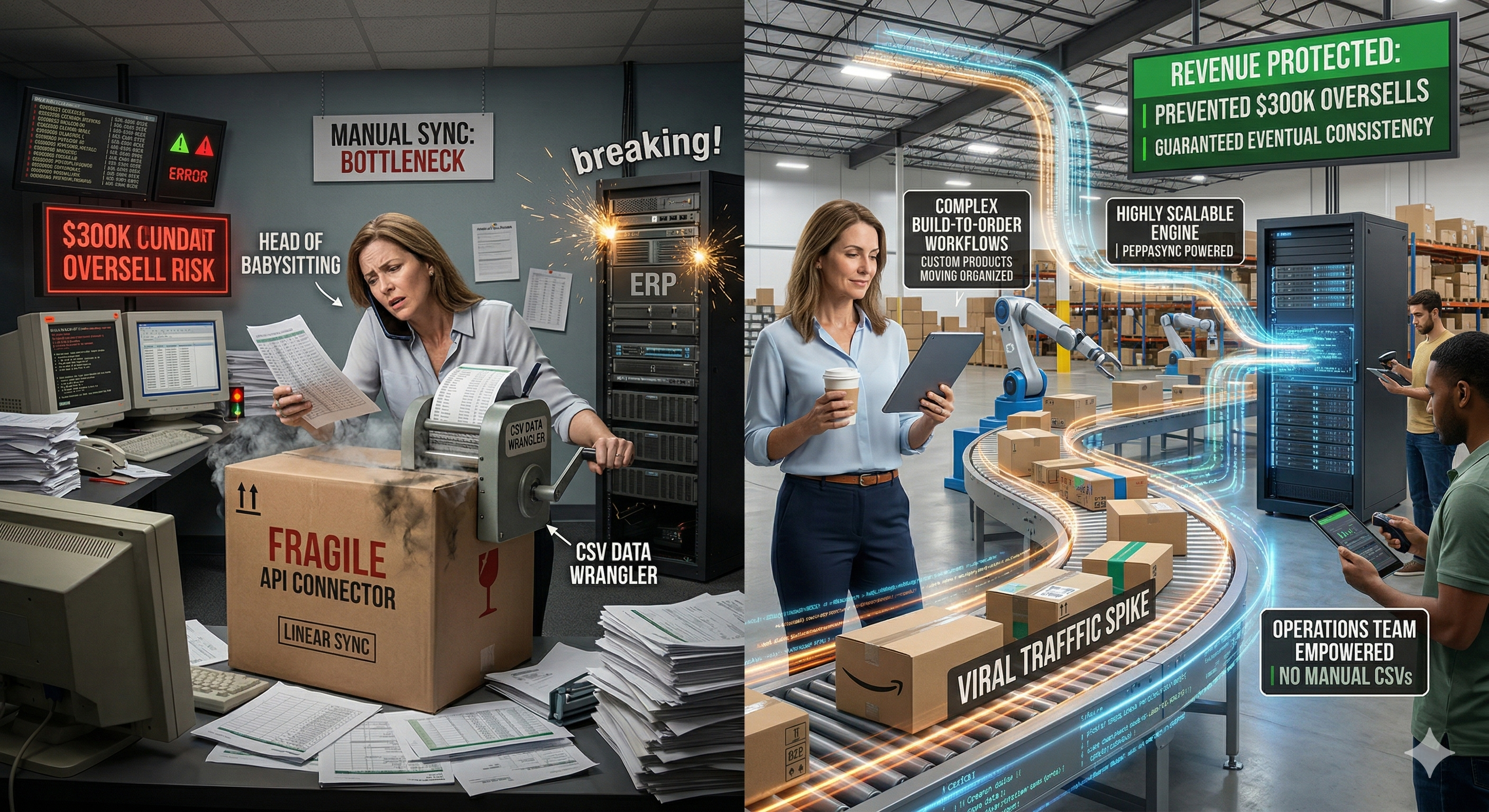
When your Head of Ops doesn't have to babysit a fragile API connector, when your warehouse immediately receives clean data despite traffic spikes, and when you can run complex Build-to-Order workflows without breaking your ERP—you aren't just improving IT efficiency. You are fundamentally changing how your business scales.
 The Bottom Line Impact:
- Prevent $300K oversells through guaranteed eventual consistency.
- Capitalize on viral traffic spikes without crashing your API limits.
- Empower operations teams with automated logic routing instead of manual CSV wrangling.
- Transform your tech stack from a liability into a highly scalable engine.
The Question Every Ops Leader Should Ask
How do you scale a modern, complex e-commerce brand when your underlying data pipe still processes orders one-by-one?
Operations leaders no longer need to accept sync failures as "just part of e-commerce." Generation 3 middleware is proving to be the difference between losing $300K in a silent drop and effortlessly scaling a viral launch.
The companies winning today aren't just selling faster—their data is flowing smarter.
Ready to bulletproof your data pipeline? Stop letting bad payloads bring your warehouse to a halt. Discover how Peppasync’s Asynchronous Logic Engine can transform your operational stability.