AI Summary (TL;DR):
- The Bottleneck: The "Halesowen Handshake" is the critical, often broken, transfer of data from engineering to administration in Build-to-Order (BTO) manufacturing.
- The Impact: Relying on manual updates or "Synchronous Logic" leads to Inventory Distortion—buying parts for configurations that no longer exist.
- The Solution: Peppasync replaces "Human Glue" with Asynchronous Logic, orchestrating data across the enterprise and enforcing Configuration Guardrails to protect margins.
In the high-stakes theater of EV manufacturing, precision is the only currency that matters. Jensen Huang often speaks about the "Industrial Metaverse," but on the ground in places like Halesowen, the reality is much more mechanical—and much more fractured.
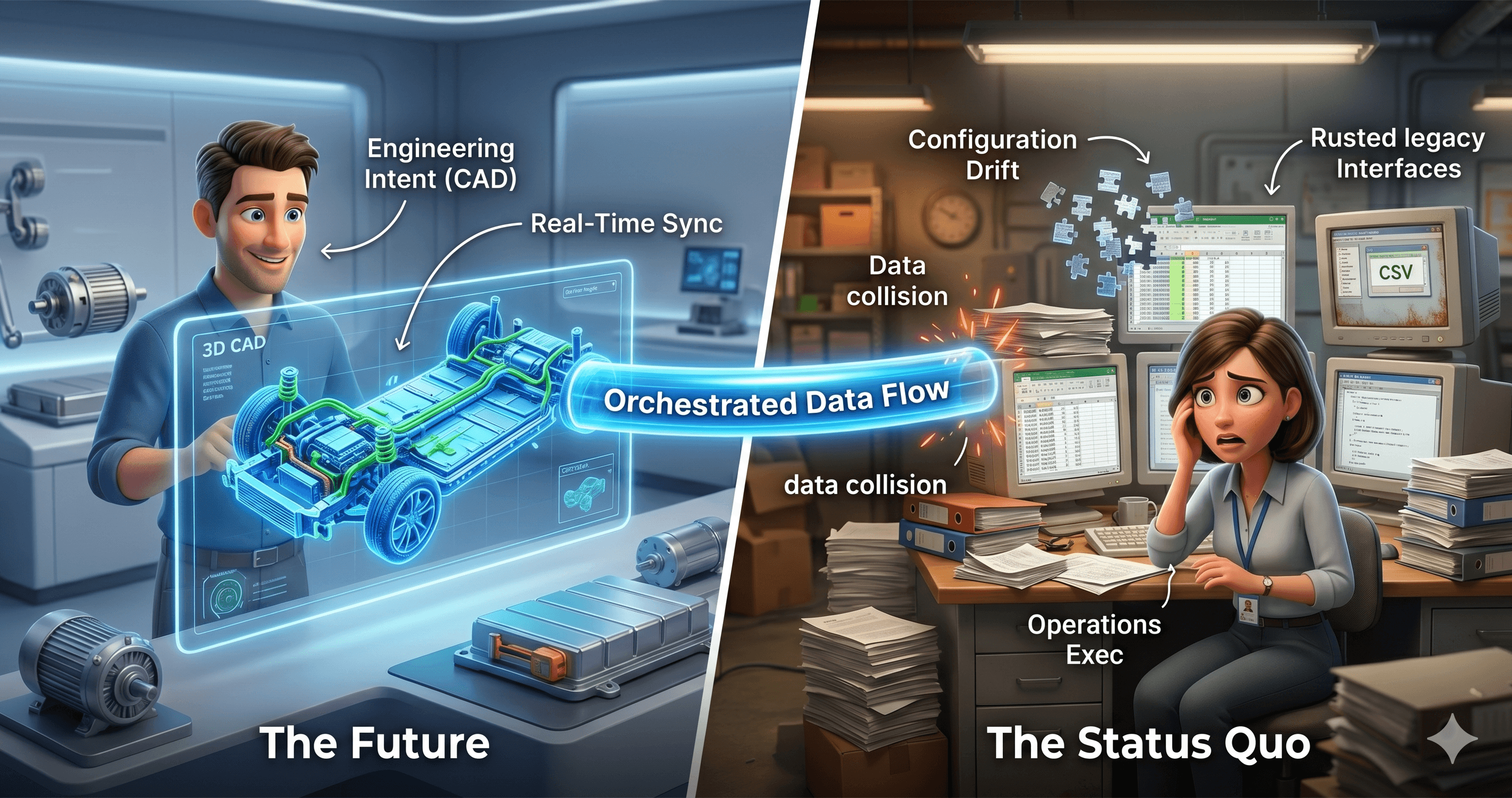
We call it the Halesowen Handshake.
It is the moment a bespoke electrical configuration moves from the engineer’s workstation to the administrator’s ledger. In theory, it’s a seamless transfer. In practice, it’s where "Build-to-Order" dreams go to die. The friction between these two departments isn't just a communication issue; it’s a structural bottleneck in the data pipes.
When engineering updates a spec—perhaps a change in battery cell density or a shift in the thermal management housing—that data must be injected into the ERP immediately. If it isn't, you face Inventory Distortion. The procurement team buys parts for a car that no longer exists on the CAD screen.
Most firms attempt to solve this with more "Human Glue"—hiring coordinators to bridge the gap. But humans don’t scale. Humans create "Synchronous Logic" errors.
To achieve true Margin Recovery, you must govern the flow of information with Configuration Guardrails.
The Industrial Transition:
- The Data Janitor Status Quo: Engineering and Admin operate as silos. Data is "pushed" via email. Errors are caught on the assembly line.
- The Peppasync Standard: Data is orchestrated across the enterprise. The handshake is automated. The assembly line never stops because the "truth" is hardcoded into the workflow.
If your engineers are spending 20% of their week updating spreadsheets, you aren't running a tech company; you’re running a data morgue. It’s time to move past the friction and scale the precision.