The Monday Morning Sync-Error Ritual That’s Costing Retailers Billions
AI Summary (TL;DR): Mid-market brands lose massive revenue when "real-time" synchronous middleware bottlenecks during traffic spikes. This linear processing creates API rate limit crashes and oversold inventory. The solution is migrating to "Generation 3" Asynchronous Logic Engines, which process data in parallel and guarantee data flow without crashing your ERP.
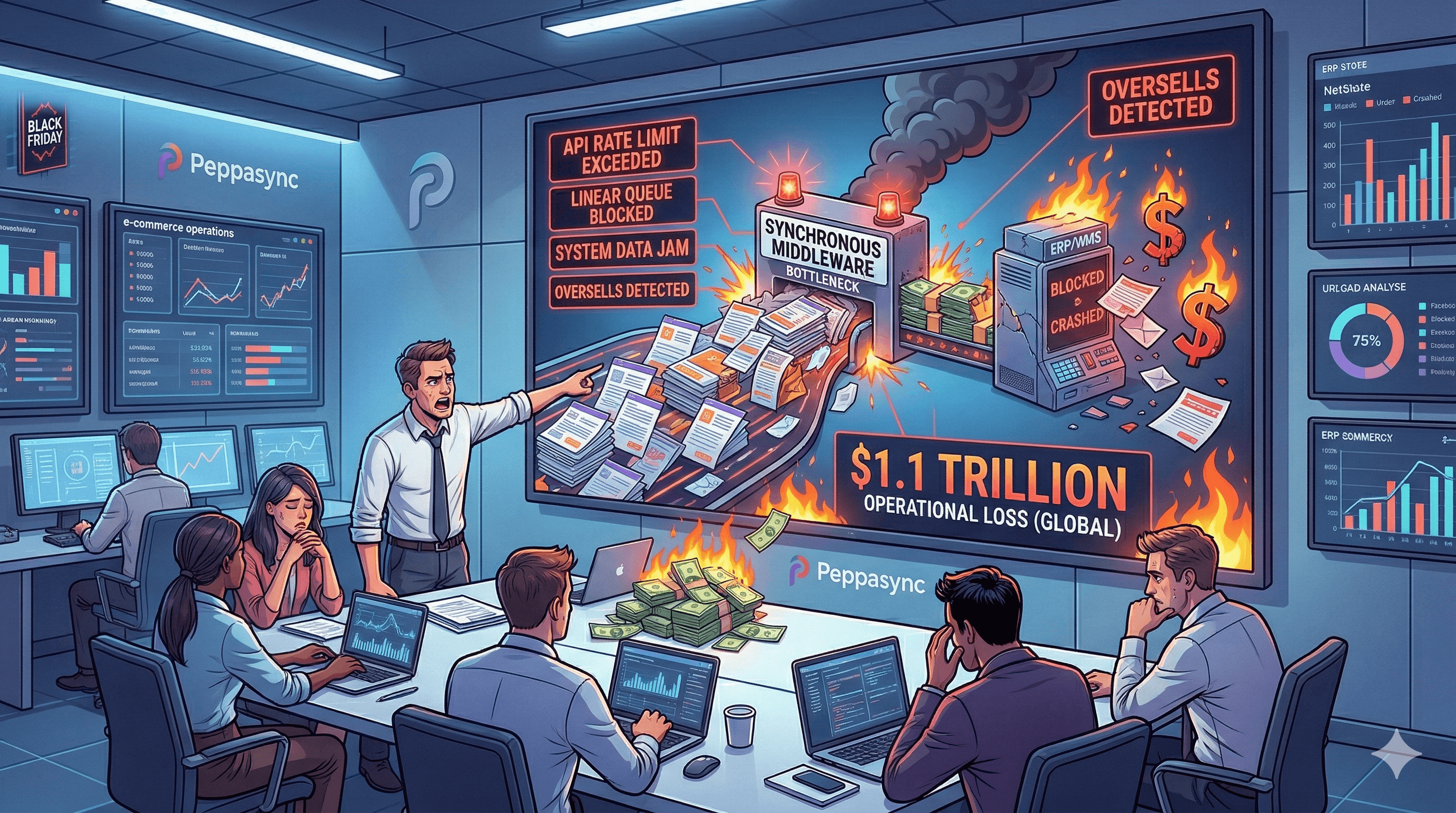
Picture this: It’s Monday morning. You’re the Head of Operations. Your weekend revenue dropped 15%, but more alarmingly, your customer service queue is up 400% with complaints about "ghost inventory" and canceled orders. You are about to sit through the most expensive post-mortem in corporate America.
VP of E-com: "Why did we lose 15% in revenue when traffic was up?"
You (Head of Ops): "We ran out of stock on the top five SKUs on Saturday afternoon. Shopify showed zero inventory."
VP of E-com: "But the warehouse said we had 2,000 units on Friday."
You: "We did. But on Saturday morning, a TikTok went viral. 1,000 orders hit Shopify in ten minutes. Our middleware tried to sync them line-by-line to the ERP. The ERP hit its API rate limit and blocked the connector. By the time the connector unblocked at 4 PM, it had missed the inventory update signal, and Shopify marked the items out of stock. We had the inventory, but our middleware couldn't move the data."
VP of E-com: "So we sat on 2,000 units of hot inventory during a viral spike because a 'dumb connector' chokes on high traffic. This meeting is over."
Sound familiar? This scenario plays out in operations war rooms across the retail industry every single day. The cost? $1.1 trillion lost globally in retail each year due to inventory inefficiencies and delayed operational decision-making.
But this painful ritual represents more than just operational frustration—it reveals which generation of data integration logic your company is trapped in.
The Three Generations of Retail Middleware Logic
Generation 1: Point-to-Point batching - "What Data Moved Yesterday?"
Timeline: 1990s-2010s Logic: Scheduled CSV exports, basic iPaaS batching. Response Time: 12 to 24 hours. Operational Impact: Reactive damage control.
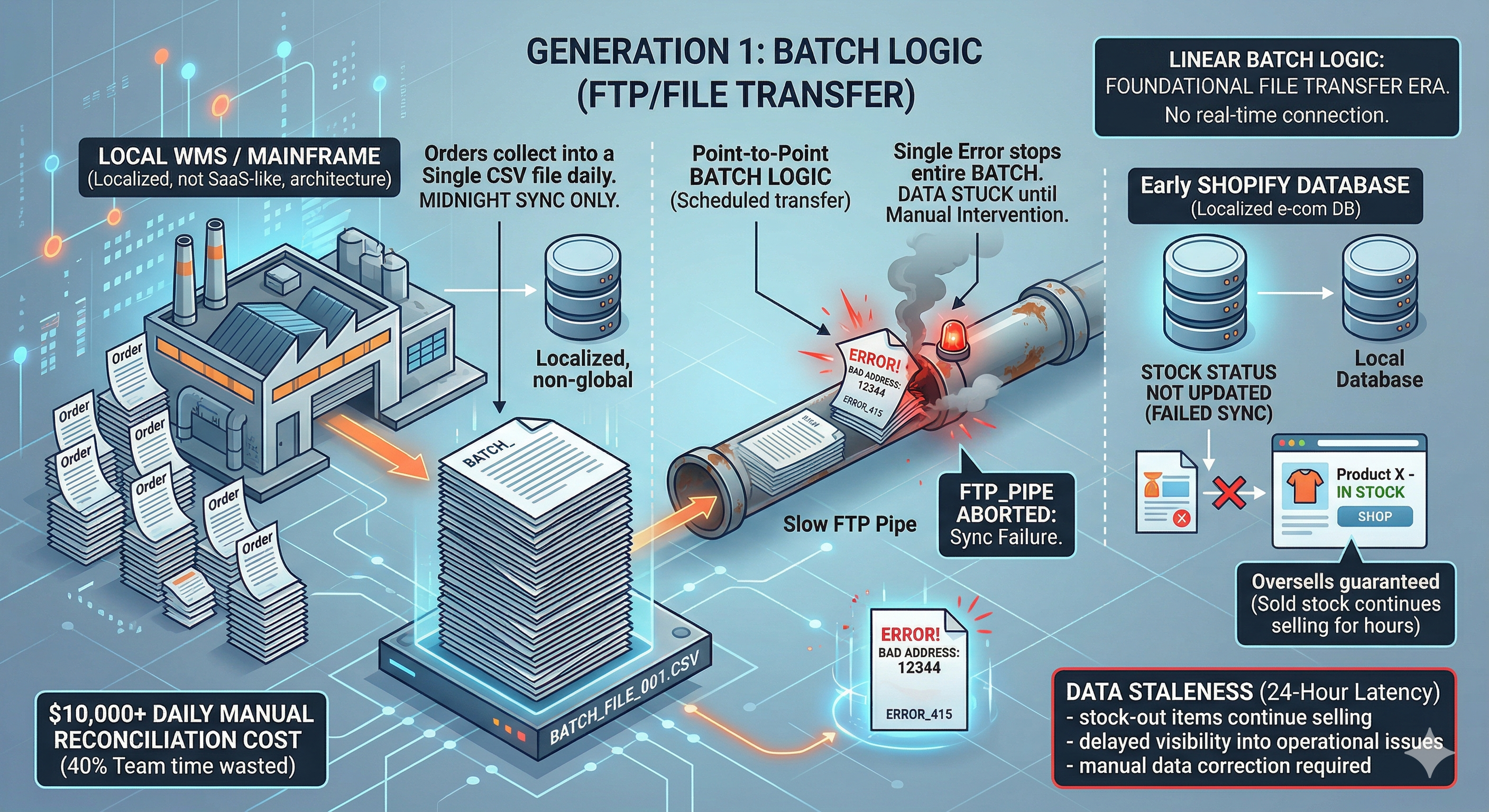
This is where many retail teams still live. They rely on scheduled syncs (e.g., sync inventory at midnight). They are forever looking backward, trying to reconcile stock levels that are already wrong by the time the CSV finishes importing.
The Hallmarks:
- Daily inventory updates.
- Manual CSV uploads to clear sync errors.
- Total reliance on IT to fix broken connectors.
- Operating "blind" on weekends.
Generation 2: Synchronous "Real-Time" Connectors - "Why Is the Sync Blocked?"
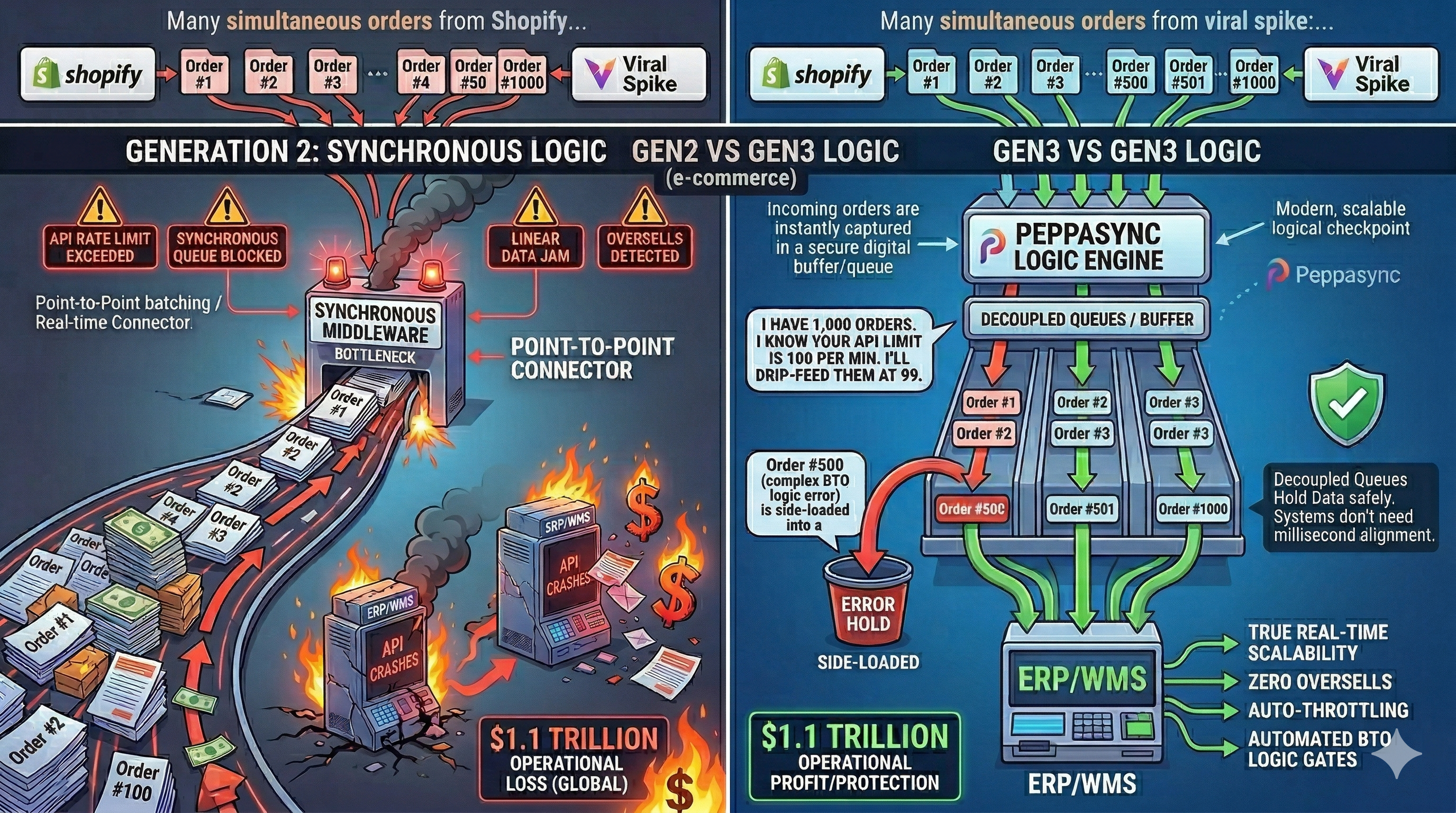
Timeline: 2010s-Present Logic: API-based, linear processing (Order 1, then Order 2, then Order 3). Response Time: Seconds to hours (highly unstable during spikes). Operational Impact: Fast reaction during low traffic, fatal collapse during high traffic.
This generation promised "real-time" sync. You bought a popular iPaaS or "smart connector." It uses APIs, which is progress, but its logic is fundamentally flawed for high-growth modern commerce. It operates synchronously.
Back to Our Monday Meeting - Three Hours Later:
VP of E-com: "I thought we paid for real-time integration."
You: "It is 'real-time,' but it’s linear. It forces Order 1 to hit the ERP before it will process Order 2. When 1,000 orders dropped, it tried to hammer the ERP API with 1,000 consecutive requests. The ERP saw this as a DDoS attack and triggered an API rate limit, blocking us for three hours. The queue just backed up until it timed out. 'Real-time' only works if traffic is slow."
The Hidden Costs:
- Oversells: Shopify sells inventory the ERP hasn't deducted yet because the linear queue is backed up.
- Ghost Inventory: The connector chokes on an error, fails to update Shopify, and you miss sales on available stock.
- API Crashes: "Dumb" connectors trigger ERP rate limits, shutting down all data flow.
Generation 3: Asynchronous Logic Engines - "How Do We Process Everything, Always?"
Timeline: Present-Future Logic: Decoupled systems, parallel processing, eventual consistency. Response Time: True, stable real-time (milliseconds). Operational Impact: Proactive flow, automated error handling, infinite scalability.
This is the necessary evolution for modern operations. Generation 3 middleware doesn't just ask "can I connect A to B?" It asks, "How do I process this logic intelligently, regardless of system state?"
The Same Scenario - Reimagined with Peppasync:
Saturday, 2:47 PM - Traffic Spike A viral TikTok drops 1,000 orders.
The Asynchronous Logic Engine (Peppasync): Captures all 1,000 orders in milliseconds. It does not try to hammer the ERP immediately. It decouples them, holding them safely in a parallel queue.
Peppasync to ERP: "I have 1,000 orders. I know your API limit is 100 requests per minute. I will now drip-feed these to you at exactly 99 requests per minute."
Peppasync (Automated Logic): "Order #500 has a weird custom BTO (Build-to-Order) configuration that the WMS doesn't recognize. I will side-load Order #500 into an 'Error Hold' bucket and automatically text the Head of Ops. Crucially, I will continue processing Orders #501 through #1,000 without missing a beat."
Saturday, 3:00 PM: Inventory is perfectly synced. No API rate limits were triggered. Zero oversells.
Total time from problem to automated solution: 0 minutes.
What Makes Generation 3 (Asynchronous Logic) Different
True Scalability via Parallel Processing
Generation 3 middleware is a multi-lane superhighway, not a single toll booth. If you get 10,000 orders, they are processed in parallel, matching the exact ingestion speed of your target systems (ERP, WMS, 3PL).
Eventual Consistency (The Anti-Oversell Weapon)
Systems don't need to be perfectly in sync at every exact millisecond—they just need a guarantee they will align. Asynchronous logic safely buffers data, guaranteeing that even if your ERP goes offline for maintenance, Shopify orders are captured and held, ready to sync the microsecond the ERP wakes up.
Automated Logic Gate Handling for BTO
For Build-to-Order or custom operations, logic must precede fulfillment. Generation 3 engines can "hold" an order until a pre-payment clears, a CAD file is generated, or factory capacity is confirmed—automatically routing the data only when the business logic gates are met.
Native API Intelligence
The engine understands the limits of NetSuite, Microsoft Dynamics, or Shopify. It throttles traffic intelligently, preventing API crashes rather than just reacting to them.
Tools Like Peppasync Are Leading This Transformation
While many mid-market brands are stuck managing CSVs (Generation 1) or fighting API rate limits on "smart connectors" (Generation 2), market leaders are moving to Peppasync.
Peppasync provides the Asynchronous Logic Engine that mid-market operations teams need to scale complex, high-volume commerce—especially BTO (Build-to-Order)—without technical debt or technical training.
The evolution of middleware isn’t just about faster connections; it's about shifting from reactive data fixing to proactive operational flow. We’re moving from analyzing why the sync failed to automating successful data logic.
Those Monday morning post-mortems? In Generation 3 operations, those problems never happened in the first place.
Which generation is your operations team operating in? Discover how Asynchronous Logic can transform your operational flow from reactive to proactive.